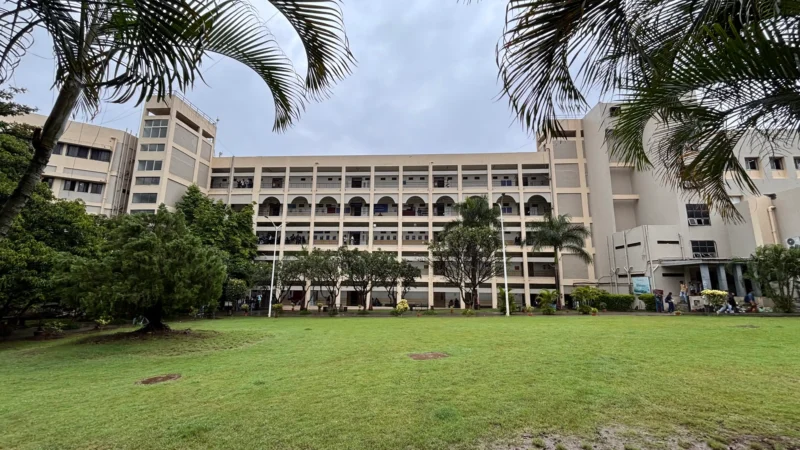
college

Pune: COEP Technological University | Fergusson College | MIT-WPU | Mumbai: University of Mumbai | St. Xavier's College | IIT Bombay | Nagpur: VNIT Nagpur | RTMNU | Nashik: KTHM College | Sandip University | Aurangabad: Dr. Babasaheb Ambedkar Marathwada University | MGM College | Kolhapur: Shivaji University | DKTE Society | Solapur: Walchand Institute of Technology | Amravati: Sant Gadge Baba Amravati University
All India & Maharashtra Cities
Pune

Vishwakarma Institute of Technology (VIT Pune)

Vishwakarma Institute of Technology (VIT Pune) Vishwakarma Institute of Technology (VIT Pune) is an AICTE-approved private engineering institute established in 1983 in Pune, Maharashtra. It is affiliated to Savitribai Phule Pune University (SPPU) and holds autonomous status. VIT Pune is distinct from VIT University in Vellore. It operates independently under the Vishwakarma Group of Institutions, Pune, and admits students exclusively through DTE Maharashtra CAP using MHT CET and JEE Main scores. As per NIRF 2025, VIT Pune is ranked #101 in Engineering. This places it among the top 110 engineering institutions in India. The institute is located in Bibwewadi, Pune, Maharashtra. It offers 3,720 B.Tech seats across 12 specialisations, making it one of the larger private engineering colleges in the Pune region. The Computer Engineering department is the largest, with 720 seats. Visit our website Vishwakarma Institute of Technology (VIT Pune) Course Duration Location Status Bachelor of Technology [B.Tech] 4 years Pune Apply Now Bachelor of Technology [B.Tech] {Lateral} 3 years Pune Apply Now Master of Technology [M.Tech] 2 years Pune Apply Now Ph.D 3 years Pune Apply Now Bachelor of Engineering [BE] (Piping Engineering) 4 months Pune Apply Now Are you searching a new College? Apply Now International Conference Top Courses B.Tech M.Tech PhD Bachelor of Engineering [BE] (Piping Engineering) News Number and Configuration of Systems – 17, Intel Core 2Duo2.2Ghz, 1GB RAM, 160GB HDD, Logitek Keyboard Mouse, Color Monitor, 6 USb, 1 Serial, 1 Parellel Port. Total Number of System connected by LAN – 10 Curricula and syllabi for each of the programmes as approved by the MSBTE. Office Address 666, Upper Indira Nagar, Bibwewadi, Pune, Maharashtra 411037 Office Email admissions@vit.edu Contact Detail +91 8793428634

No Comments Read More
Pune

Pune Institute of Computer Technology (PICT)

Pune Institute of Computer Technology (PICT) Pune Institute of Computer Technology (PICT) is a private autonomous engineering institute established in 1983 in Pune, Maharashtra. It is affiliated to Savitribai Phule Pune University (SPPU) and approved by the All India Council for Technical Education (AICTE). PICT holds NAAC accreditation and NBA accreditation for its B.Tech engineering programmes. PICT does not currently appear in the NIRF Engineering 2025 top 100 ranked list.The 5-acre campus is located at Dhankawadi, Survey No. 27, near Trimurti Chowk, in the southern part of Pune. The campus includes a well-equipped central library, dedicated laboratory blocks for computer and electronics disciplines, and on-campus hostel facilities for both male and female students. Visit our website Pune Institute of Computer Technology (PICT) Course Duration Location Status B.Tech: Computer Engineering 4 years Dhankawadi, Pune Apply Now B.Tech: Information Technology 4 years Dhankawadi, Pune Apply Now B.Tech: Electronics and Telecommunication Engineering 4 years Dhankawadi, Pune Apply Now B.Tech: Artificial Intelligence and Data Science 4 years Dhankawadi, Pune Apply Now B.Tech Lateral Entry (All Branches) 3 years Dhankawadi, Pune Apply Now M.Tech: Computer Engineering 2 year Dhankawadi, Pune Apply Now M.Tech: Data Science 2 years Dhankawadi, Pune Apply Now M.Tech: Electronics and Communication Engineering 2 years Dhankawadi, Pune Apply Now Are you searching a new College? Apply Now International Conference Top Courses B.Tech B.Tech {Lateral} M.Tech News Number and Configuration of Systems – 17, Intel Core 2Duo2.2Ghz, 1GB RAM, 160GB HDD, Logitek Keyboard Mouse, Color Monitor, 6 USb, 1 Serial, 1 Parellel Port. Total Number of System connected by LAN – 10 Curricula and syllabi for each of the programmes as approved by the MSBTE. Office Address Survey No. 27, Near, Trimurti Chowk, Bharati Vidyapeeth Campus, Dhankawadi, Pune, Maharashtra 411043 Office Email admissions@pict.edu Contact Detail 020 2437 1101

No Comments Read More
Pune

COEP Technological University

COEP Technological University, Pune COEP Technological University (formerly College of Engineering Pune) is a government autonomous university established in 1854, making it one of the oldest engineering institutions in Asia. It is granted autonomy by the University Grants Commission (UGC) and is governed under the Government of Maharashtra. COEP Technological University Act 2022 conferred university status to the institution. As per NIRF 2025, COEP Technological University is ranked #90 in Engineering in India, with a score of 47.31. The university’s strong performance in Graduation Outcomes (67.69) reflects its consistent placements and higher study rates. Visit our website COEP Technological University Course Duration Location Status B.Tech (all 9 engineering branches) 4 years Pune Apply Now B.Plan 4 years Pune Apply Now B.Tech Lateral Entry (Civil, Electrical, E and TC, Instrumentation, Mechanical, Metallurgical) 3 years Pune Apply Now B.Tech Lateral Entry (AI/ML, CSE, Manufacturing) 3 years Pune Apply Now MBA (Finance, Business Analytics, Marketing, Operations) 2 years Pune Apply Now MBA (HRM) 2 year Pune Apply Now M.Tech Premium (AI/ML, Data Science, Sensor Technology) 2 years Pune Apply Now M.Tech Standard (22 specialisations) 2 years Pune Apply Now M.Tech Standard (SC/ST) 2 years Pune Apply Now PhD (14 disciplines) Minimum 3 years Pune Apply Now Are you searching a new College? Apply Now International Conference Top Courses B.Tech B.Plan B.Tech Lateral Entry (Civil, Electrical, E and TC, Instrumentation, Mechanical, Metallurgical) MBA (HRM) News Number and Configuration of Systems – 17, Intel Core 2Duo2.2Ghz, 1GB RAM, 160GB HDD, Logitek Keyboard Mouse, Color Monitor, 6 USb, 1 Serial, 1 Parellel Port. Total Number of System connected by LAN – 10 Curricula and syllabi for each of the programmes as approved by the MSBTE. Office Address National Law School of India University, Gnana Bharathi Main Rd, Opp. NAAC, Teachers Colony, Nagarbhavi, Bengaluru, Karnataka – 560072 Office Email admissions.pace@nls.ac.in Contact Detail (Fax) +91 80 2316 0535

No Comments Read More
Pune

National Law School of India University (NLSIU)

National Law School of India University (NLSIU), Bengaluru. National Law School of India University (NLSIU) is a public autonomous university established under the National Law School of India Act (Karnataka Act 22 of 1986). It was the first National Law University in India, with its first undergraduate batch entering in 1988. NLSIU is a pioneer of the five-year integrated law degree in India. The Chancellor is the Chief Justice of India, and the university was established through collaboration between the Bar Council of India, the Karnataka government, and the legal academia. NLSIU is recognised by UGC and the Bar Council of India (BCI).Established in 2019, the college is affiliated with the Maharashtra University of Health Sciences, Nashik, and recognized by the Medical Council of India. It offers undergraduate medical courses and postgraduate courses leading to skilled and competent medical professionals. Visit our website National Law School of India University (NLSIU) Course Duration Location Status BA LLB (Hons.) 5 years Bengaluru Apply Now LLB (Hons.) 3 years Bengaluru Apply Now LLB (Hons.) 3 years Bengaluru Apply Now Master of Public Policy (MPP) 2 years Bengaluru Apply Now LLM (Business Law / Commercial Law / Criminal Law / Human Rights / Technology Law / International Laws) 1 year Bengaluru Apply Now Master of Business Law (MBL) 1 year Bengaluru Apply Now Ph.D (Law) Minimum 3 years Bengaluru Apply Now Are you searching a new College? Apply Now International Conference Top Courses Doctor of Medicine [MD] Bachelor of Science [B.Sc] (Nursing) Bachelor of Ayurvedic Medicine and Surgery M.B.B.S. News Number and Configuration of Systems – 17, Intel Core 2Duo2.2Ghz, 1GB RAM, 160GB HDD, Logitek Keyboard Mouse, Color Monitor, 6 USb, 1 Serial, 1 Parellel Port. Total Number of System connected by LAN – 10 Curricula and syllabi for each of the programmes as approved by the MSBTE. Office Address National Law School of India University, Gnana Bharathi Main Rd, Opp. NAAC, Teachers Colony, Nagarbhavi, Bengaluru, Karnataka – 560072 Office Email admissions.pace@nls.ac.in Contact Detail (Fax) +91 80 2316 0535

No Comments Read More
Pune

Whales: Giants of the Ocean

Whales: Giants of the Ocean Whales are among the largest and most remarkable animals on Earth. These marine mammals live in oceans around the world, from warm tropical waters to the cold seas surrounding the poles. Life Beneath the Surface Although whales spend their lives in water, they breathe air through blowholes located on top of their heads. They must regularly return to the surface to breathe before diving again in search of food or traveling through the ocean. Whales are warm-blooded, give birth to live young, and nurse their calves with milk. A thick layer of fat called blubber helps protect them from cold water and stores energy during long migrations. Two Main Groups Whales are generally divided into baleen whales and toothed whales. Baleen whales filter small animals from the water using flexible plates inside their mouths. This group includes blue whales, humpback whales, and gray whales. Toothed whales use teeth to catch fish, squid, and other prey. Many of them also use echolocation, producing sounds and listening for returning echoes to understand their surroundings. Sperm whales, belugas, and orcas belong to this group. The Blue Whale The blue whale is the largest known animal to have ever lived. An adult can grow longer than a city bus and weigh well over one hundred tonnes. Despite its enormous size, it feeds mainly on tiny crustaceans called krill. Communication and Migration Whales communicate using clicks, whistles, pulses, and complex songs. Some sounds can travel across great distances underwater. Humpback whales are especially famous for their long, patterned songs. Many species migrate thousands of kilometres each year. They often feed in cold, nutrient-rich waters before traveling to warmer regions where they mate and give birth. Protecting Whales Commercial hunting once caused severe declines in many whale populations. Today, whales also face threats from fishing gear, ship collisions, underwater noise, pollution, and changes to ocean ecosystems. Conservation programs, safer fishing practices, protected habitats, and international cooperation can help whale populations recover. Protecting whales also supports healthier oceans because these animals play an important role in marine food webs and nutrient cycles.

No Comments Read More
Pune

Examiner les conditions générales de Celsius Casino en détail

Avant de vous engager dans une nouvelle expérience de jeu, il est essentiel de vous pencher sur les détails des accords proposés. En effet, des chiffres précis peuvent avoir un impact significatif sur votre expérience globale. Donc, avant toute chose, vérifiez les particularités financières ainsi que les exigences de mise, qui sont des éléments décisifs. Les bonus offerts, accompagnés de leurs conditions, jouent un rôle clé dans votre stratégie de jeu. Par exemple, un bonus peut sembler attractif, mais une mise élevée peut en limiter l’utilisation. Assurez-vous de consulter la section dédiée aux code promo celsius casino, car cela peut influencer votre première expérience. Type de Bonus Pourcentage Conditions de Mise Bonus de Bienvenue 100% 30x Bonus de Dépôt 50% 25x Free spins 100 tours Pas de mise Vérifiez les termes de retrait. Considérez les jeux éligibles pour les bonus. Examinez la politique de fidélité. Une analyse approfondie des modalités peut garantir que votre expérience de jeu soit à la hauteur de vos attentes. En résumé, ne négligez pas ces aspects techniques, car ils peuvent faire toute la différence entre une session de jeu plaisante ou frustrante. Comprendre les exigences d’inscription et de vérification d’identité Pour ouvrir un compte, il est nécessaire de fournir des informations précises telles que le nom, l’adresse, le numéro de téléphone et une adresse e-mail valide. Ces éléments constituent la première étape pour accéder aux services offerts. Lors de l’inscription, un mot de passe sécurisé doit également être créé, afin de garantir la protection des données personnelles. La vérification d’identité se déroule en plusieurs phases. Une fois le compte créé, le joueur sera invité à soumettre des documents justificatifs. Cela inclut généralement une pièce d’identité officielle (carte d’identité ou passeport) et un justificatif de domicile. Ces documents peuvent être envoyés via une interface dédiée ou par e-mail, en fonction des préférences de la plateforme. Document Format accepté Pièce d’identité JPEG, PNG, PDF Justificatif de domicile JPEG, PNG, PDF Il est recommandé d’utiliser des documents récents, de moins de trois mois, pour faciliter le processus de vérification. En général, la validation prend entre 24 et 48 heures, bien que des délais plus longs puissent survenir si les documents ne sont pas clairs ou si des informations sont manquantes. Une attention particulière doit être portée à l’exactitude des informations fournies. Des erreurs dans les données personnelles peuvent entraîner des retards dans la vérification. Pour éviter des complications, il est conseillé de vérifier deux fois les informations avant de les soumettre. Utiliser un mot de passe fort et unique. Conserver les documents au format requis. Vérifier la date de validité des pièces d’identité. Analyse des conditions de mise des bonus et promotions Une attention particulière doit être accordée aux exigences de mise pour les bonus offerts. Par exemple, un bonus de 100 € avec un coefficient de mise de 30x signifie que le joueur doit parier 3000 € avant de pouvoir retirer des gains associés à ce bonus. Vérifiez toujours le montant total à parier, car une exigence trop élevée peut limiter les bénéfices réels du bonus. Les promotions variées peuvent être avantageuses, mais il est essentiel de lire les termes spécifiques à chaque offre. Les bonus d’argent réel, les tours gratuits et d’autres incitations peuvent avoir des critères différents. En général, les tours gratuits offrent un coefficient de mise moins strict, souvent autour de 10x ou 20x, ce qui peut être plus attrayant pour les joueurs occasionnels. Type de bonus Montant Exigence de mise Durée de validité Bonus de bienvenue 100 € 30x 30 jours Tours gratuits 50 10x 7 jours Bonus de rechargement 50 € 25x 14 jours À prendre en compte : les jeux éligibles pour satisfaire aux exigences de mise peuvent inclure des machines à sous ou des jeux de table. Souvent, les machines à sous contribuent à 100 %, tandis que les jeux de table ne contribuent qu’à 10 % ou 20 %. Il est donc judicieux de prioriser les jeux qui maximisent le chemin vers le retrait des fonds. Vérifiez la durée de validité du bonus. Examinez les jeux qui encaissent dans les mises. Comparez les exigences de mise entre différentes promotions. Faites attention aux restrictions nationales.


No Comments Read More
Pune

Whales: Giants of the Ocean

Whales: Giants of the Ocean Whales are among the largest and most remarkable animals on Earth. These marine mammals live in oceans around the world, from warm tropical waters to the cold seas surrounding the poles. Life Beneath the Surface Although whales spend their lives in water, they breathe air through blowholes located on top of their heads. They must regularly return to the surface to breathe before diving again in search of food or traveling through the ocean. Whales are warm-blooded, give birth to live young, and nurse their calves with milk. A thick layer of fat called blubber helps protect them from cold water and stores energy during long migrations. Two Main Groups Whales are generally divided into baleen whales and toothed whales. Baleen whales filter small animals from the water using flexible plates inside their mouths. This group includes blue whales, humpback whales, and gray whales. Toothed whales use teeth to catch fish, squid, and other prey. Many of them also use echolocation, producing sounds and listening for returning echoes to understand their surroundings. Sperm whales, belugas, and orcas belong to this group. The Blue Whale The blue whale is the largest known animal to have ever lived. An adult can grow longer than a city bus and weigh well over one hundred tonnes. Despite its enormous size, it feeds mainly on tiny crustaceans called krill. Communication and Migration Whales communicate using clicks, whistles, pulses, and complex songs. Some sounds can travel across great distances underwater. Humpback whales are especially famous for their long, patterned songs. Many species migrate thousands of kilometres each year. They often feed in cold, nutrient-rich waters before traveling to warmer regions where they mate and give birth. Protecting Whales Commercial hunting once caused severe declines in many whale populations. Today, whales also face threats from fishing gear, ship collisions, underwater noise, pollution, and changes to ocean ecosystems. Conservation programs, safer fishing practices, protected habitats, and international cooperation can help whale populations recover. Protecting whales also supports healthier oceans because these animals play an important role in marine food webs and nutrient cycles.

No Comments Read More
Pune

Whales: Giants of the Ocean

Whales: Giants of the Ocean Whales are among the largest and most remarkable animals on Earth. These marine mammals live in oceans around the world, from warm tropical waters to the cold seas surrounding the poles. Life Beneath the Surface Although whales spend their lives in water, they breathe air through blowholes located on top of their heads. They must regularly return to the surface to breathe before diving again in search of food or traveling through the ocean. Whales are warm-blooded, give birth to live young, and nurse their calves with milk. A thick layer of fat called blubber helps protect them from cold water and stores energy during long migrations. Two Main Groups Whales are generally divided into baleen whales and toothed whales. Baleen whales filter small animals from the water using flexible plates inside their mouths. This group includes blue whales, humpback whales, and gray whales. Toothed whales use teeth to catch fish, squid, and other prey. Many of them also use echolocation, producing sounds and listening for returning echoes to understand their surroundings. Sperm whales, belugas, and orcas belong to this group. The Blue Whale The blue whale is the largest known animal to have ever lived. An adult can grow longer than a city bus and weigh well over one hundred tonnes. Despite its enormous size, it feeds mainly on tiny crustaceans called krill. Communication and Migration Whales communicate using clicks, whistles, pulses, and complex songs. Some sounds can travel across great distances underwater. Humpback whales are especially famous for their long, patterned songs. Many species migrate thousands of kilometres each year. They often feed in cold, nutrient-rich waters before traveling to warmer regions where they mate and give birth. Protecting Whales Commercial hunting once caused severe declines in many whale populations. Today, whales also face threats from fishing gear, ship collisions, underwater noise, pollution, and changes to ocean ecosystems. Conservation programs, safer fishing practices, protected habitats, and international cooperation can help whale populations recover. Protecting whales also supports healthier oceans because these animals play an important role in marine food webs and nutrient cycles.

No Comments Read More

Sign In

Register

Reset Password

Please enter your username or email address, you will receive a link to create a new password via email.